MODBUS
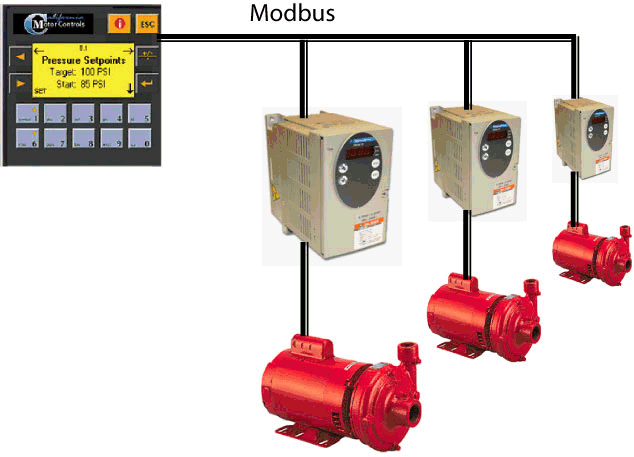
Modbus is a serial communications protocol originally published by Modicon (now Schneider Electric) in 1979 for use with its programmable logic controllers (PLCs). The main reasons for the use of Modbus in the industrial environment are:
developed with industrial applications in mind
openly published and royalty-free
easy to deploy and maintain
moves raw bits or words without placing many restrictions on vendors
Modbus allows for communication between many (approximately 240) devices connected to the same network, for example a system that measures temperature and humidity and communicates the results to a computer. Modbus is often used to connect a supervisory computer with a remote terminal unit (RTU) in supervisory control and data acquisition (SCADA) systems.
The mobile substation or portable substation is fully equipped with different power system equipments, and must be able to be shipped from one place to another with fully assembled mode.
Most motors in control applications are just regular DC motors. A few are AC, and a few are true servomotors.
A true servo motor is optimized for high speed control systems. Specifically, you want fast linear response. To get this, they are typically somewhat high in cost, relatively low armature inertia, high torque (to give good acceleration). Often have marginal cooling (i.e. not rated for high duty cycle).
Electromagnetic induction is the production of a potential difference (voltage)
]across a conductor when it is exposed to a varying magnetic field.
Michael Faraday is generally credited with the discovery of induction in 1831
Faraday's law of induction is a basic law of electromagnetism predicting how a
magnetic field will interact with an
electric circuit to produce an electromotive force (EMF). It is the fundamental
operating principle of transformers,
inductors, and many types of electrical motors, generators and solenoids.
A photodiode is a type of photodetector capable of converting light into either current or voltage, depending upon the mode of operation.[1] The common, traditional solar cell used to generate electric solar power is a large area photodiode.
How a proximity sensor works :
A proximity sensor is a type of sensor which detects the presence of nearby objects called target without any physical contact. There are different types of proximity sensors such as inductive proximitysensor, capacitive proximity sensor, ultrasonic proximity sensor, photoelectric proximity sensor. Depending on the type of technology used proximity sensor emits an electromagnetic or electrostatic field, or a beam of electromagnetic radiation (infrared, for instance), and looks for changes in the field or return signal when target comes closer to the face of sensor.
There are different kinds of proximity sensors. They are
Capacitive proximity sensor
Inductive proximity sensor
Photoelectric proximity sensor
Ultrasonic proximity sensor
The advantages of the non contact proximity sensors are:
No physical contact required with the target to be detected, therefore, no moving parts so no friction and wear out.
Fast switching characteristics
Unlimited number of switching cycles since there is no mechanical contact
Can work in harsh conditions
Any type of target material can be detected.
A proximity sensor is used in many applications such as in mobile phones and for level sensing. In Iphone proximity sensor is used to deactivate the touch screen when the phone comes near to the face.